
First Figs: Camden’s Vincent Millay and Topsham’s Normena MacKinnon
by Marla Miller
Prize competitions for young creatives have long been a driving force in the nurturing of new poets. Well before the breakthrough of “Renascence,” in 1906 a fourteen-year-old Edna St. Vincent Millay submitted her first poem to St. Nicholas magazine, “Forest Trees,” celebrating “Monarchs of long forgotten realms, ye stand; / Majestic, grand: / Unscarred by Time’s destructive hand.” Further recognition quickly followed, with Vincent’s poem “The Land of Romance” receiving St. Nicholas’ “Gold Badge,” its highest honor for young contributors. In the four years after her high school graduation, Millay published five more poems there, work recognized with other awards. The final submission, “Friends” (May-October 1910), won the cash prize and Honor Member designation for its “clever rhyming” and “ingenious setting,” at which point Millay wrote the editor to say she would be moving on; she would spend her five dollars on a volume of Robert Browning’s poems.
Some fifteen years later, another Maine teenager would receive early recognition for her poetry. On May 5, 1925, Topsham’s Normena MacKinnon attended Millay’s appearance at Bowdoin College’s Institute of Literature. Millay was “marvelous beyond words,” Normena’s sister Mary recorded in her diary. At evening’s end they saw Edna get into a car; thrilled to be “so near her,” “Normena left her hat in all the excitement!” The next day, Normena and her sister raced to the Bowdoin College library to find and copy Millay’s poems.
Just days later, on May 10, the Portland Sunday Telegram announced The Scholastic magazine’s “Witter Bynner Poetry Prize Contest” for high school students (expanding the existing competition for college students). The deadline for entries was November 15th.
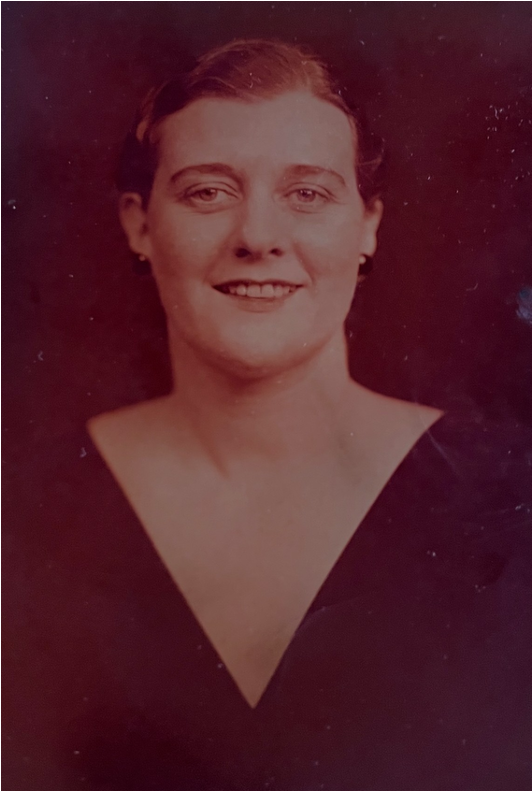
Normena was already actively writing and publishing poetry in Brunswick High School’s literary venue, the Orange and Black. An early verse celebrated how the poet “With his flaming pen / Makes words breathe life and live again.” Another apology “to a Chem Teacher” began “It was not all my fault— / If there had been no sun, / No window, through which / I could see, I swear that / I’d have told you what a / Solvent and a valence means / In Chemistry.”
The poem she would submit to the Witter Bynner competition, “Colored Streamers,” had not appeared elsewhere before:
Today,
The Inspector of souls came.
He examined mine carefully,
He entered every room—
He even went so far as to
Open some of the cupboards.
In one he found a mass
Of colored paper,
Streamers they were.
He asked me why I keep them!
I lied to him—
I said to him
Because they make such
A nice noise when they're shaken.
I did not tell him
They make me think of you
In their brightness and gayety—
For he would not have thought
That reason enough!
Perhaps she had begun writing this poem in summer 1925, after the wedding of her older sister Elizabeth. The early morning after the ceremony, which unfolded in the lawn of the family’s home, found Normena and her sister outside by 6:00 AM, sweeping up confetti and streamers. But the streamers in her poem took another form. The narrator, like many high school students, is preoccupied with authority figures and the impulse to conceal things from them. In this case, it is both affection and the ways colorful paper evokes joy, maybe as tokens of festive memory, or simply as a stand-in for delight.
Normena’s poem did not win a prize, but in the weeks after the competition’s conclusion, as contributors began submitting work to publications, the competition’s organizers were encouraged to publish their own collection of the strongest submissions. The result would be the volume Saplings. The May 20, 1926, edition of the Brunswick Record announced the publication of Normena’s poem. Of 13,000 submissions, just 54 were selected for publication.
MacKinnon decided a career in the arts was for her. Like young Millay, she perceived blurred lines between poetry and performance, and, in October 1926, she enrolled in the American Academy of Dramatic Arts in New York. In the 1930s and ’40s, she enjoyed a career as a platform performer, appearing onstage on the lecture circuit, concentrating principally on the interpretation of poems by Millay, as well as Amy Lowell, with a sprinkling of Elinor Wylie, Sara Teasdale, Emily Dickinson, and others.
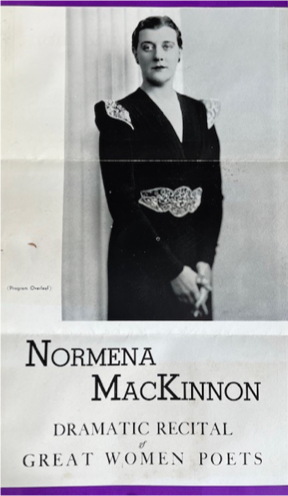
MacKinnon’s work as a poet and performer of poetry is the central concern of my manuscript-in-progress, tentatively titled Comradeship of Beauty—a reference to MacKinnon’s longtime union with the painter and poet Gertrude Tiemer. The book will explore MacKinnon and Tiemer in the context of a circle of creatives that included the painter and poet Marsden Hartley; poet, writer, and illustrator Robert P.T. Coffin; poet and publisher Harold Vinal; pianist and painter Gertrude Kuebler; painter Chenoweth Hall and her partner novelist Miriam Colwell, and others.
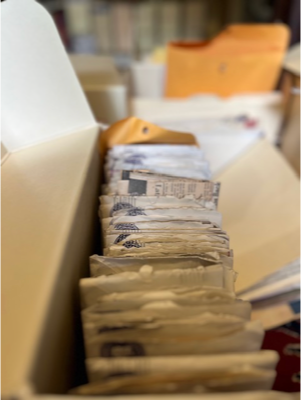
A month at Millay House Rockland’s Maine Coast Writer’s Retreat in April 2026—happily, National Poetry Month—was pivotal to the development of the work. Comfortably ensconced at 198 Broadway, I embraced the extended peace and quiet of the setting to concentrate on the roughly 50 of MacKinnon’s readings known to date, triangulating between surviving correspondence, newspaper coverage, and MacKinnon’s files to reconstruct to the extent possible the Millay poems selected for performance, and audience responses to them. Among other insights, I was able to discern patterns in her choices—evidence of where she aligned with, and departed from, the canon emerging from anthologies. Much to my surprise, as my vision for the project took shape, I also found myself with the time, quiet, and inspiration to map out most of the book’s analysis and argument, and even to begin writing.
In the Millay House’s support of my project, I imagine I feel much like young Normena MacKinnon in finding encouragement from The Scholastic. Just as Millay’s emergent career had been mapped out before her through youth publications contests, Normena discovered a corresponding template that validated her choice to pursue a creative career—and what better model than Millay herself to inspire writers, whether past or present, excited by the performative agency of poetry, “words [that] breathe life and live again,” as her youthful voice enthusiastically put it!
Marla Miller, Distinguished Professor of History (emerita) at UMass Amherst, is a longtime historian of women and work in New England and the Mid-Atlantic. After 25 years of research and writing on American women’s lives before 1820, Comradeship of Beauty is her first foray into the twentieth century and the history of poetic performance and production. Marla Miller used her time in the MHR Maine Writer’s Retreat to work on her current project.
Photo credits: Marla Miller
