
Crabwalk Race Blue Ribbon
by Claire Millikin
In second grade, I won the field day crabwalk race.
Troweling backwards – arms, legs, thrown
behind me, reaching
into the blind-spot of fate.
Afterwards, on the bright field by pinewoods
teacher taped to my chest the winning ribbon,
a shave of blue
fluttering like an external pulse.
At recess the boy who got second
tore the ribbon from my shirt,
so teacher set him out.
But he and his older brother followed us,
Lou and me, after school into crossing woods,
pine forest acidic and piercing.
They shoved my big sister,
tallest child in the fifth grade,
hard against a sapling and it swayed
and I kicked the boys’ shins and at last bit
deep into the younger one’s blonde-haired wrist
and he bled and cried out
and his brother called me a damned witch.
Lou never protected me again.
We walked home together and apart,
the blue ribbon a captured sky
wet in my closed fist, blue
bruise rising on my sister’s shoulder.
I crawled so fast in those years before breasts,
bent backwards, hurtling into what I could not guess.
— from Ghost Crab (Sea Crow Press 2027)
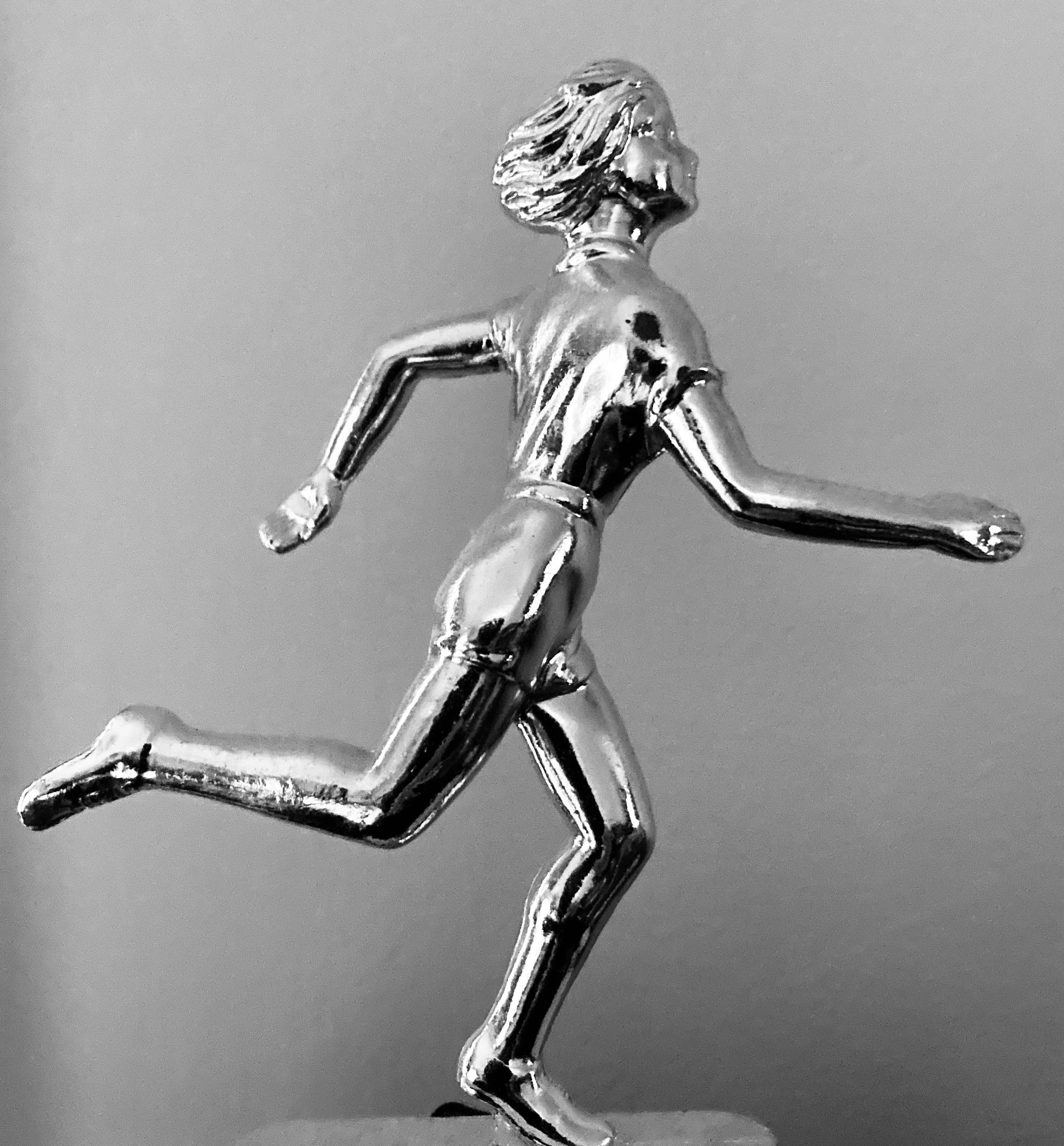
Towards the end of each schoolyear, my childhood grade school held a field day celebration. We’d be marshalled by the PE teacher, Mrs. Womble, and walk across the asphalt space that was our usual playground, down a grassed slope, assembling like scattered birds in the grassy field. Not a playing field, not a playground, not a park but, as the area where I grew up was fairly rural back then, just a plain old field next to the school. I don’t know who owned it or even if it was owned. Next to the field was a pine forest reaching miles back. I’m pretty sure all of this is gone now, as the putative New South has been razing rural spaces and putting in strip malls the many decades since I graduated from sixth grade. All that day we’d compete in races. There were other competitions but only the races interested me and now I don’t remember the other games.
Before we all hit puberty, I was the fastest runner in my class. It was a point of pride, and I’ve never fully recovered from losing that relative speed (I was a D-1 college track recruit, so by some measures I still ran fast but not fast enough to beat same-age XY runners). Anyway, as a kid I competed in and won most of the field day races. The poem Crab Walk Race Blue Ribbon, as its title implies, is about the crabwalk race (a race where you bend backwards on all fours scuttling without being able to see where you’re going). The brothers described in the poem were white-blonde kids and mean. The fight to keep the blue ribbon went much as described in the poem.
In adolescence, into college, I ran competitively and hated competing. I loved running, loved training, for years ran fifty to seventy miles a week with something very close to joy. But I always hated racing. I used to get so nervous before races I’d consider throwing myself off a bridge. Kathy Ormsby, an extraordinarily gifted North Carolina runner, tragically had done just that during a high-stakes college race, suffering life altering injuries. She spoke, afterwards, of the extreme pressures she felt to win. My mother, in an uncharacteristic show of maternal concern mixed with a characteristic lack of empathy and tact, mobilized Kathy as a kind of admonitory specter, Don’t jump off a damn bridge, she’d say in her thick Georgia accent. Meaning: running races is pure silliness. During cross-country season my senior year of college, I quit. Told the coach I hated competing. He shrugged, You’ll be back for spring track, but he was wrong. I was twenty-years old when I ran my last competitive footrace (not counting a few mother-son relay races my kid and I ran when he was too young to refuse). Those formative years as a competitive athlete have shaped how I see poetry prizes.
Maybe because I entered poetry competitions as a middle-aged adult, not publishing until I realized that it didn’t matter one way or the other, I initially thought poetry competitions would be laidback compared to track meets. As a college athlete at the Penn Relays my coach had denied me the meal money we were guaranteed for travel meets (regulations require providing food for traveling college athletes) because my weight was up. I was five-foot-seven-inches tall, one-hundred-twenty-two pounds, muscular and so lean I didn’t have periods. In poetry competitions, one is never asked to step on a literal scale or be denied food because of gaining a couple pounds. And yet, poetry competitions are not laidback. Unlike track races, where how you place in the race depends almost entirely on how fast you run, poetry competitions are judged by people. There are no known poetry gods who determine what is a good poem. A friend who’s an experienced writer and has sat on many book competition prize panels (albeit prose, since that’s her medium) told me: The book that wins is usually not the best book, it’s just the book no one hates.
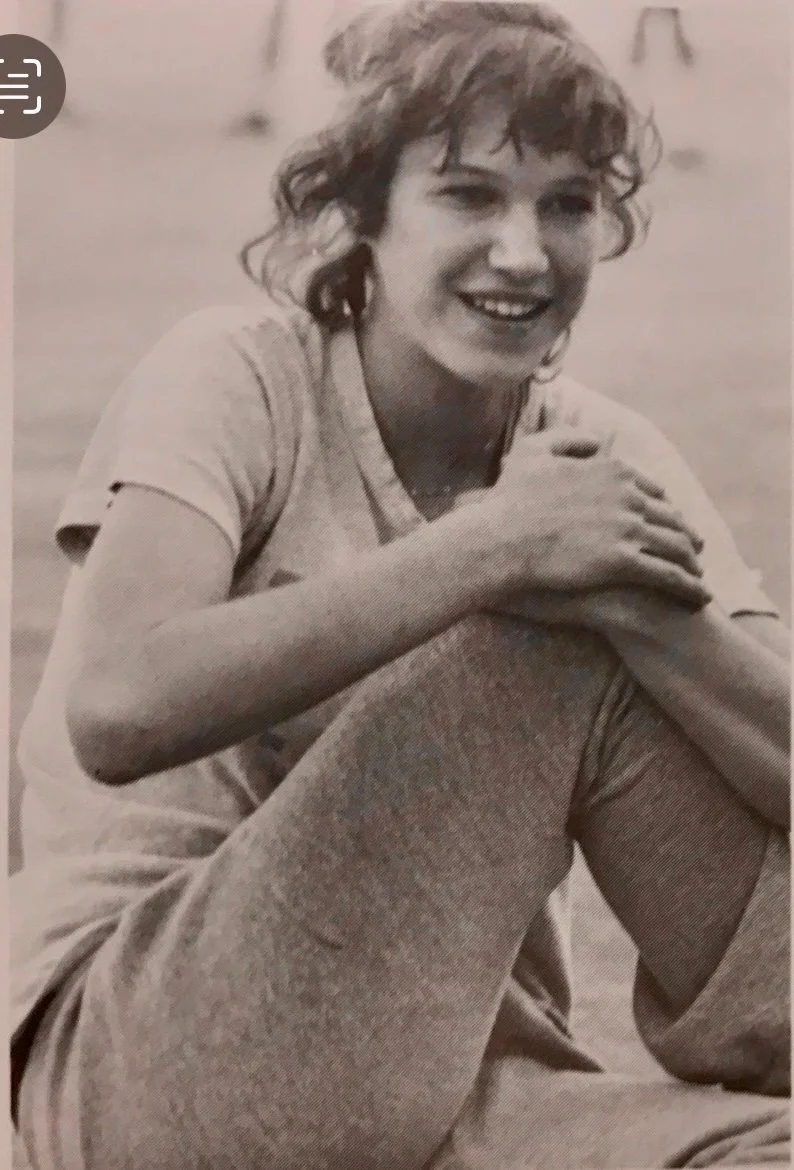
Photo credit Claire Millikin
There is a kind of coach-athlete relationship that inflects the publisher-writer relationship when it comes to prizes. Having published five poetry books with Unicorn Press, four with 2Leaf Press, and one with Littoral Books, I’ve come to feel as if I trust these publishers rather deeply, as if it’s they who will face death with me because it’s they who face prizes with me. To be sure, small press publishers, like coaches, often have outsized personalities. Coach Braxton once hollered, as I was at the starting line of an invitational meet: You’re a lean, mean machine! whatever that might’ve meant. Gabrielle David, of 2Leaf Press, told me You don’t seem to know it, but you’ve got the juice. I may have the juice but most of the time I don’t win the prize. I used to love the part of cross-country races where we’d all disappear into the woods and the crowds couldn’t see us. I feel like that also about poetry competitions: I wish there was a stretch of woods where we could all disappear, each to themselves keeping (as poet Sharon Olds writes) our own best time.
A notable difference between competing as a college runner and entering poetry book competitions is where these prizes sit within late-stage capitalism. In 2026, college athletes can monetize their labor (though I’d guess XX college middle distance runners aren’t raking in the money) but that was not the case when I was in college. What winning races in high school did was get me into an elite college that purported not to offer athletic scholarships but in fact provided funding for any admitted athlete. Which is of course an athletic scholarship. Poetry prizes are grotesquely embedded in capitalist structures. They are the artistic equivalent of the vacuous “world’s best cup of coffee.” Buy this book, it has a sticker on it! Or perhaps the literary equivalent of “nine out of ten dentists agree” your teeth and your poetry shine the brightest. Winning a race never felt connected to the transcendent joy of a long run through the woods. Poetry book competitions likewise feel invariably slick and flat compared to the gorgeous pleasure when writing flows and one is alone. Without this there is nothing – All other riches be – as is the twitter of the bird – heard opposite the sea, Emily Dickinson (who never won a poetry competition but earned culinary accolades) says it best.
I hate poetry competitions with an intensity that I’ve generally not found in other poets. I hate the feeling of worthlessness that comes with losing as well as the sense of pointlessness that comes with winning. It’s eerily like my former relationship to being a competitive runner. I loved running, loved the fields and forests I could merge with while I ran in rural Georgia, rural Carolina, as a kid. I even loved running in New Haven as a college athlete, on a ten-mile run discovering what my training partner and I referred to as the “one pretty street in New Haven.” And I hated the formal competitions all that training led to. These days, I love writing, live for writing, and hate competing through writing. But just as with being a middle-distance runner, it’s difficult to avoid competing as a writer. Competitions throng the path. Theoretically one could train hard and never compete. One could only write and never publish. But in all my post-competitive decades as a casual runner, I’ve never trained anywhere near as hard as when I was competing. Today, I run because it feels great. If I feel tired, I stop. I couldn’t guess what my 5K time is these days. So, with poetry, sure, I could say, I’m done with competitions and the devil take the hindmost. But I’m still afraid of the devil, afraid of folding too early into the silence that awaits us all. I have a new book out and am gearing up for putting it into a few prize competitions. Some part of me is still childish enough to care about a blue ribbon. Maybe some part of me is even willing, if pushed, to fight for it.
Claire Millikin is the author of over ten collections of poetry, including Magicicada, winner of the Foreword Indie Award for Poetry and an Independent Press Award Distinguished Favorite, and most recently Night Light, both from Unicorn Press. Millikin is the recipient of a 2021 Maine Literary Award for Enough! Poems of Protest and Resistance (Littoral Books, 2020). Her forthcoming collection Ghost Crab will be published by Sea Crow Press. Claire teaches for the University of Maine system and for Maine Media Workshops.
