
Someone Had to Notice: Literary Competitions and the Making of Edna Millay
by Lucia Graves
The first time my writing was singled out happened almost by accident.
In fifth grade, my classmates and I were asked to put our heads down and spend the class period writing an essay about what it meant to be graduating from elementary school. I remember almost nothing about the assignment except the image I seized upon: a golden rope ladder winding around a tower, each rung another year of school, pulling us upward to the clouds. The imagery seems hopelessly overblown now, but I was proud of it then.
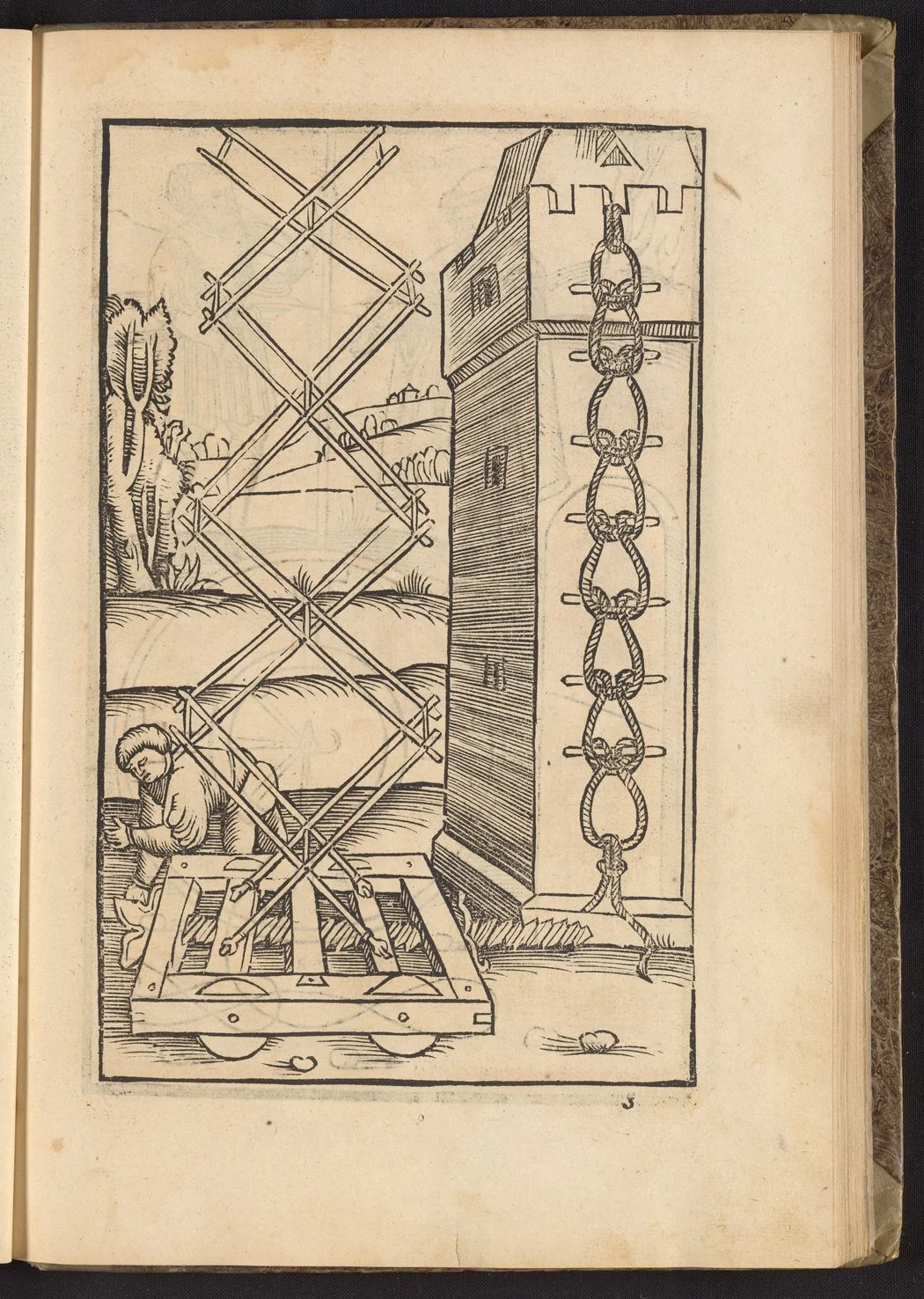
Telescoping siege device and rope ladder, woodcut, 1529, from Vier Bücher der Ritterschafft, Roy G. Neville Historical Chemical Library, sciencehistory.org (public domain).
Apparently, this educational Jack and the Beanstalk metaphor resonated with my fellow ten- and eleven-year-olds, because after we read our essays aloud in small groups, mine was one of a handful chosen to be read by the teacher to the whole class. My classmates ultimately voted for it to be read at graduation, and a few weeks later I stood before the school and read it aloud myself.
Looking back, I doubt anyone else remembers the essay or that I read. But I do. What stayed with me wasn't the applause, or "winning," or even really the essay itself. It was the realization—still difficult to fully articulate—that having other people recognize something in my words could change the way I thought about myself. For the first time, writing wasn't simply something I enjoyed. It became part of my identity, one of the first things I believed I might actually be good at.
Nearly three decades later, researching the early life of Edna St. Vincent Millay, I found myself thinking about that classroom again. Her diaries are filled with traces of a young writer gradually learning a related lesson on a far greater scale.
There was the teacher who kept her after school because she couldn't believe a child had written such a composition unaided. There was an early column in the school paper. Then came honorable mentions, and then gold and silver badges from St. Nicholas magazine—a popular monthly children's magazine founded in the 1870s, whose contests awarded publication and cash prizes alongside public recognition. "One of our smart and talented High School girls, Miss E. Vincent Millay, age 14 … was awarded a gold by the Century Co., publishers of St. Nicholas Magazine, in their League contest for best poem," The Camden Herald proudly announced on Friday, March 8, 1907 under the headline "Camden Girl Wins Prize." The article also published Millay's winning poem, "Land of Romance," in full, concluding: "It shows talent and we trust Miss Millay will keep on developing her talent for writing."
Such stories ran again on July 30, 1909, when Millay won a silver badge for "Young Mother Hubbard," as well as on Friday April, 22, 1910, when she won a cash prize for her poem "Friends," with the paper noting how St. Nicholas's judges praised her skillful use of a double rhyme for each couplet, rendered "with ease and grace that a grownup and practiced author could not easily surpass." These articles, too, published her poems in full.
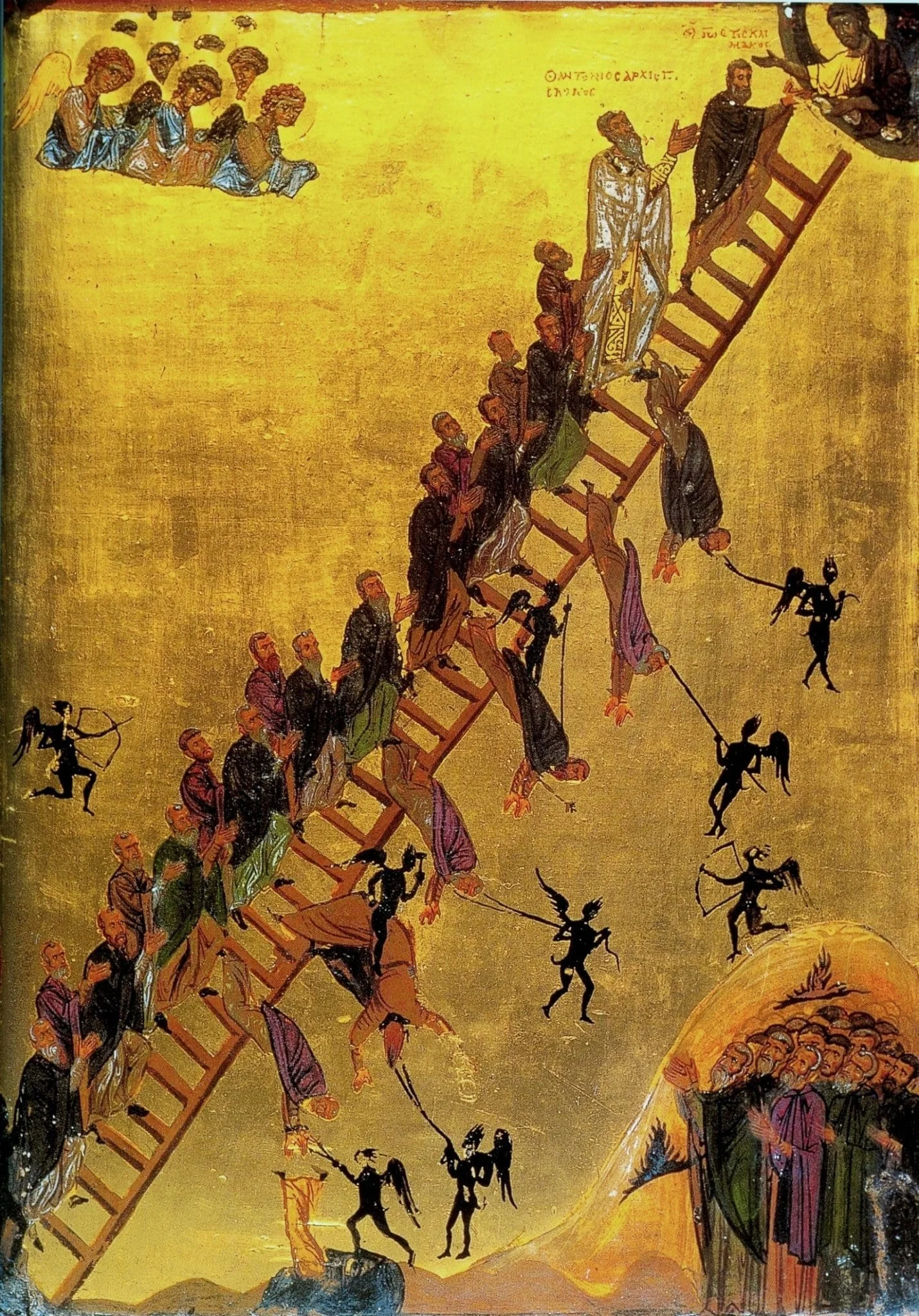
Ladder of Divine Ascent, Icon, Saint Catherine’s Monastery, Sinai (photo: Pvasiliadis, Wikimedia, public domain).
St. Nicholas was one of the great literary magazines of its era, publishing established writers alongside young talent and giving children's work an audience that extended far beyond home and school. Its competitions offered publication, cash prizes, and, perhaps most importantly, the chance to be read.
For Millay, that audience quickly grew. Her winning poem, "Land of Romance," was republished in another New York-based magazine, Current Literature, introducing her work to adult readers as well. It was this widening circle of recognition that convinced her family they were witnessing something extraordinary. "Vincent was a genius," her sister Norma later recalled to Millay biographer Nancy Milford. "Although each of the sisters had sent things to St. Nicholas. . . we never got a bite. Vincent got everything."
By the time she was too old to compete, Milford noted, she had won every poetry prize the magazine offered.
Norma's account shows how the awards and publications affirmed a conviction the family had held all along. But the accolades were clearly important to Millay too, as we know from the care with which she recorded each badge and mention in her sporadic but faithful diaries. And then there were the poems themselves, the half imagined and the fully realized alike, carefully preserved by Millay between the pages like so many pressed flowers.
She saved them, I think, because she understood something before literary historians did: that these moments mattered, too. Perhaps she knew only that they mattered to her. We know now that they became evidence not only of who she was, but of all she would become.
Those moments of recognition mattered all the more because there was so little in her circumstances to suggest that literary greatness was possible, much less likely. Looking back, Millay was so precocious and her talent so prodigious, that her rise can seem inevitable. But no literary rise is inevitable. Talent alone is never enough. Someone has to notice. Then someone else. And someone after that.
After her parents’ divorce, twelve-year-old Vincent moved with her mother and sisters into what biographer Nancy Milford described as “the smallest house in the poorest part of town,” the modest Camden home Cora Millay could afford. The family had little money. Even a three-dollar subscription to St. Nicholas magazine was an expense Cora worried over.
But Vincent knew enough to beg her mother to pay the fee. Because St. Nicholas offered something almost impossible for a young girl to find in a small Maine town at the beginning of the twentieth century: an audience. And it was a discerning one at that.
Those victories did more than fill a scrapbook. Each prize widened the circle of people who encountered Millay's work—from teacher to children's magazine, to hometown newspaper, to New York literary magazine. They also gave tangible form to an identity that had previously existed only as private ambition. That pattern continued after she outgrew St. Nicholas. In 1912 she submitted her masterwork, "Renascence," to The Lyric Year, an ambitious national poetry competition and anthology conceived to showcase the country's most promising new poets. Although its editor was convinced the poem would win, other judges disagreed, and it famously placed fourth.
When the anthology appeared, many readers believed the judges had gotten it wrong. Even before the prizes were announced, Jessie Rittenhouse, an officer of the Poetry Society of America, wrote to editor Ferdinand Earle calling "Renascence" "the best thing in the book ... one of the freshest and most original things in modern poetry," adding, "If it doesn't get the prize, I pity your judges."
The contest drew roughly 10,000 poems from nearly 2,000 entrants. The resulting anthology included work by many of the era's most important and promising poets—including Vachel Lindsay, Sara Teasdale, Joyce Kilmer, and Witter Bynner. That "Renascence" became the anthology's enduring masterpiece says as much about Millay's arrival as it does about the judges' misjudgment.
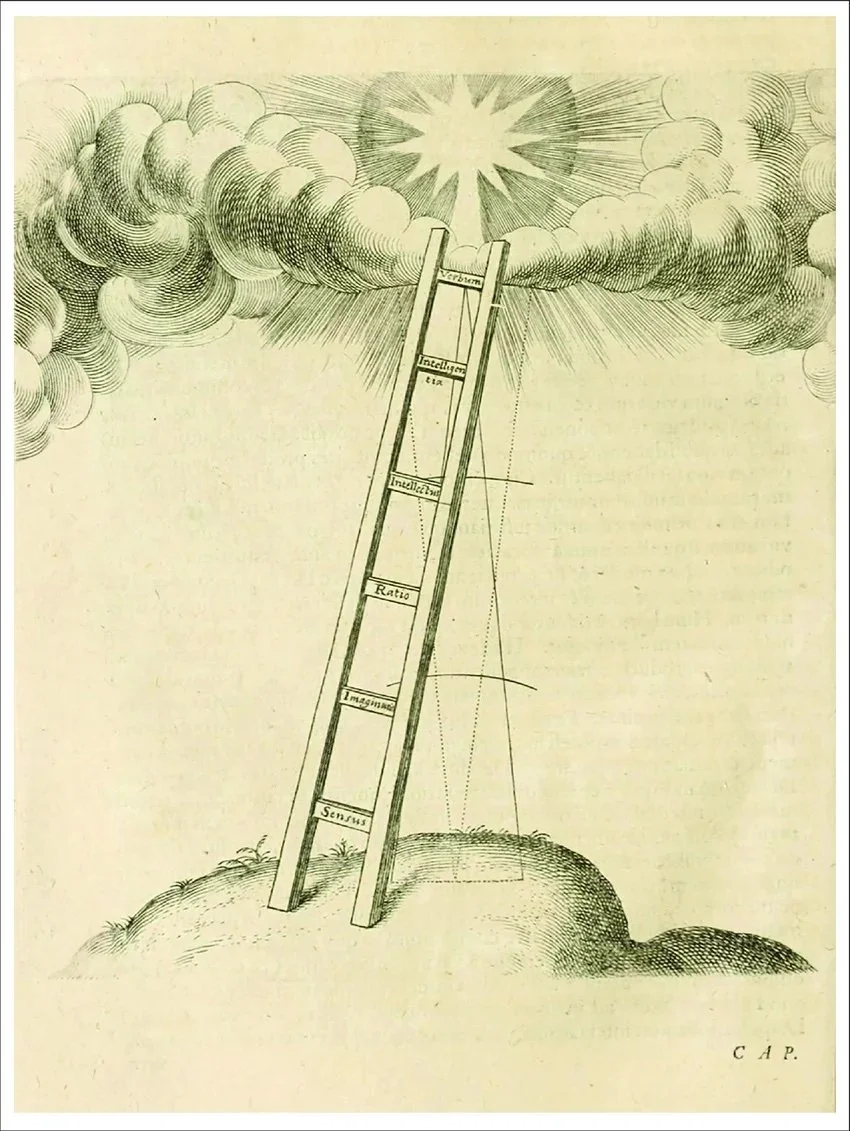
Robert Fludd, engraving from Utriusque Cosmi, public domain, courtesy of Deutsche Fotothek.
Millay's timing was extraordinary. The Lyric Year was conceived as an annual competition but appeared only once. Millay happened to submit "Renascence" in the single year the contest existed. Though the judges placed it fourth, the anthology introduced her work to precisely the editors, critics, poets, and patrons who would shape the next stage of her career.
Earlier this year, at a lecture on Edna Millay in downtown Camden, local scholar Yesha West recounted how arts patron Caroline Dow, having heard Millay recite “Renascence” at the Whitehall Inn, resolved to help send her to Vassar. An audience member asked what could possibly have inspired such generosity. West's answer was simple: "Have you read ‘Renascence’?"
Ironically, The Lyric Year did not launch Millay because it judged her poem correctly. It launched her because so many readers believed it had judged her incorrectly. Competitions don't just pass down laurels from on high: they invite argument. They introduce emerging writers to editors, patrons, and readers who might otherwise never encounter their work. Sometimes they crown the right poem. Sometimes, as in Millay's case, they inadvertently shine an even brighter light on another.
Critics of literary competitions have long worried that they encourage conformity. Marjorie Perloff, for example, has argued that the demand for a certain kind of "prize-winning" poem can produce safer work and an "extraordinary uniformity" of style. At the same time, literary scholar Howard Rambsy II has shown that, for many contemporary Black poets, competitions have also served as crucial gateways to publication, teaching positions, institutional appointments, and lasting professional recognition. Millay's story helps explain why.
Competitions do more than reward finished poems. At their best, they create occasions for remarkable work to be written, read, debated, and discovered. For Millay, The Lyric Year provided precisely the audience her work needed at exactly the moment her career was poised to begin—and perhaps just as importantly, it provided both the opportunity and the deadline that called “Renascence” forth.
Competitions do more than distribute honors. They first gather writers around the work of creation, then gather readers around what those writers have made. They create moments when a remarkable poem can suddenly find the people who change a writer's life.
Millay's story is a reminder that literary culture depends not only on great writers but also on the people and institutions willing to create the conditions in which remarkable work can emerge and find its readers.
Literary history has a habit of making genius seem preordained. But Millay’s early life tells a different story.
The early awards did not make her a great poet. They made it increasingly difficult for the world to overlook one. They also helped make it increasingly difficult for Millay to overlook herself.
Lucia J. Graves is a writer and journalist based in Midcoast Maine, where she lives with a dog, a cat, a husband, and a kindergartner—not necessarily in that order. She wrote about Millay and “The Hunt for Maine’s Most Poetic Vista” in the Midcoast Villager 2025 Summer Guide.
