
Losers
by Jefferson Navicky
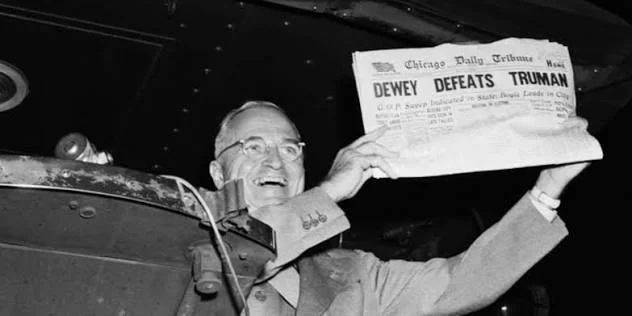
“Dewey defeats Truman”
1948, Underwood Archives/Getty Images
Sometimes it’s better to lose. Loss can create its own vacuum, a good kind of black hole. And especially for a young poet, it is good to lose a lot, so much so that you might begin to believe the poetry world is a closed door that won’t allow you admittance, because if you tell yourself that fiction while still wanting to write poems, there’s hope for you and your poetry when you do indeed find some success, and then find yourself having to write poems as a success, which is its own unique challenge when pity is not nearly as publicly accessible as it once was.
Yes, a bit of bitterness is good for the soul. Millay felt that sting after being led to believe her poem would win The Lyric Year competition, and then it didn’t even place and thus received no prize money. By the way, it’s quite ridiculous to hope for money in the poetry world, but many of us, including Millay and myself, have been tempted by prize money—“What would I do with all that money?!”—so ridiculous, and my ears burn for all the times I’ve thought it. What would a twenty-year-old girl in Camden, Maine, in 1912, do with thousands of dollars? Probably buy some nice clothes for herself and her sisters and mother. Then the money would be gone. Far better to acquire a chip on her shoulder. Far better to feel the sting of embarrassment for allowing laurels to be expected. Unlike the NBA Finals, where after a seven-game series, the best team has definitely won, poetry is far too fickle and subjective for the best poem to be expected to win anything. Far better for Millay to know she wrote a good poem, but for that poem to get snubbed. There’s nothing so instructional, so beneficial as rejection. Winning is nice, but as Tolstoy said about happy families, winners are all the same. Winners are boring. They’re always surprised. They’re always grateful, they always thank so, so many people. Losers pout, feel crushing failure, feel robbed, embarrassed, defeated, losers question everything and anything. But then, after they’ve lost, in the quiet stillness following defeat, they get back to it when no one is watching. They take that flush of disappointment and pour it into poems. Losers are my kind of people.
Jefferson Navicky is a poet, public historian, and a board member of Millay House Rockland. He probably has a cat on his lap right now.
