Ceaseless Ambition and Self-Estimate “It”: Millay in her High School Yearbook
Jen Munson on Edna St. Vincent Millay
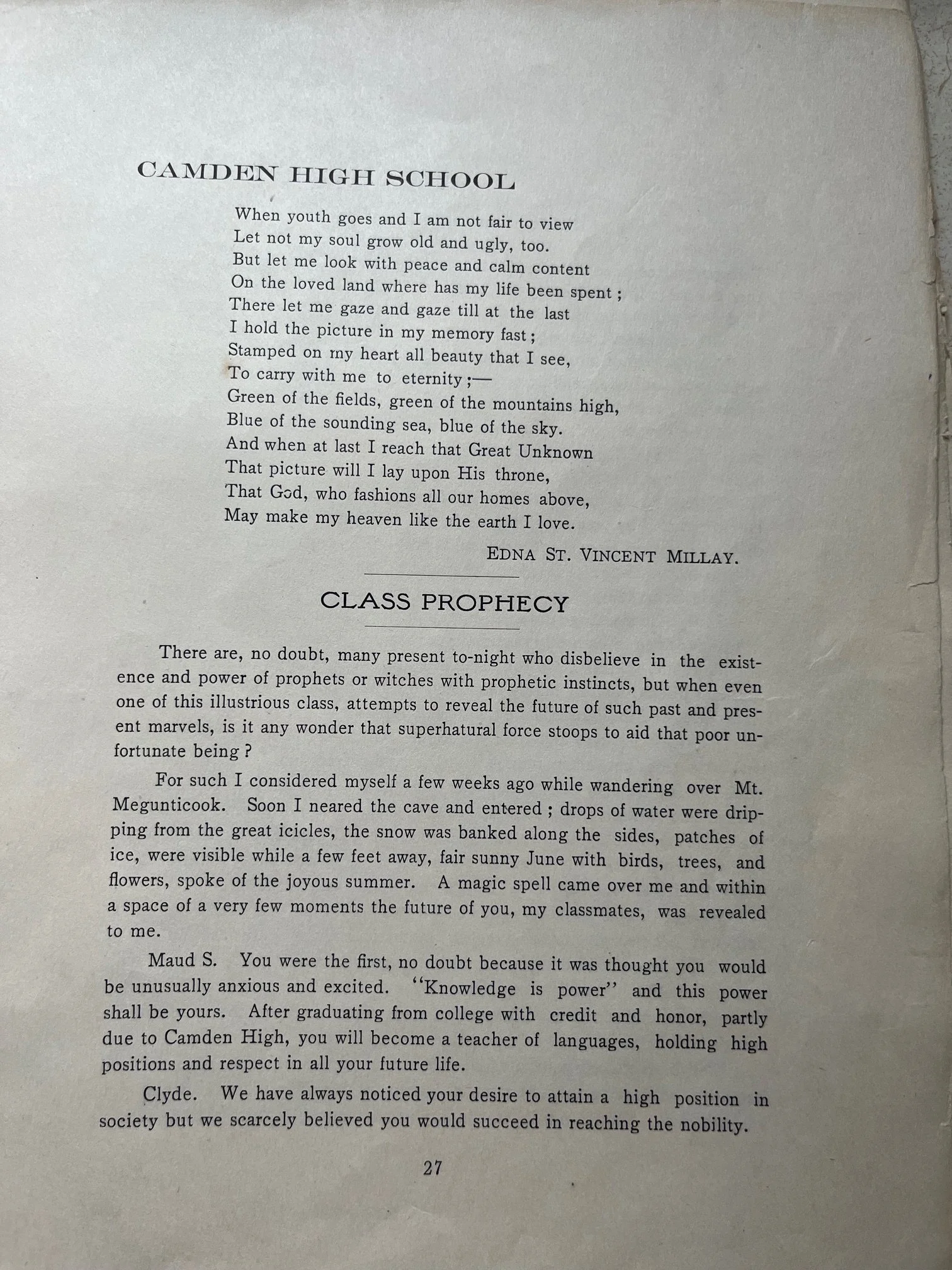
Have you ever felt like the universe has opened up in front of you and beckoned you to follow a path? This journey I have gone on with Vincent has certainly felt that way. For starters I’ve been teaching at Camden Hills Regional High School, the modern incarnation of Vincent’s alma mater, for twenty-five years, and one day back in early 2020 I was standing in the main office when I noticed someone had dropped off an old photo of the baseball team—clearly from somewhere back in the early 1900s. We are a small school, and I thought I would look through the old yearbooks in the library and see if I could find the names of the boys in the picture; I thought it would be fun to see if we could connect those photos to our current students—how cool to see a photo of your great-grandfather at your age and see he played baseball like you?
So I dove into the dusty, disorganized chaos of one hundred years of yearbooks that had not been sorted since we moved to the new high school twenty-five years before. I was flipping through The Megunticook: Commencement Number—the yearbook from 1909—when I saw her name and what her classmates wrote about her:
Class Prophecy:
“Last but not least” are you, Vincent, and do you recall the old saying the best is reserved till the last? There is much for you to accomplish in the future, so much for your ceaseless ambition to urge you to. Your writing, dramatic ability, and also your singing will serve to assist you in gaining a high position in the world. ~Mary Emily Pendleton
Presentation of Gifts:
Vincent, you have a desire to become famous in the dramatic line and you have always taken great interest in the plays given by our class. But I advise you not to take up that profession for if you do you will surely miss your calling. You would make a much better lawyer, for you are so good at arguing. You would be a valuable addition to the women’s side in discussing women’s rights. You may perhaps get some points from this book on Argumentation. ~ Harold Cummings Newton
And then I saw what she said about herself in her “Statistics of the Senior Class”:
Name: Vincent
Age: 17
Hobby: Arguing
Highest Ambition: To go abroad
Greatest Failing: Talking
Opinion of Freshies: Some are alright
Church Preference: Congregational
Self-Estimate: It
Favorite Expression: Je suis defessa! [this is a slang term, roughly meaning a dramatic “I’m exhausted!”]
Future Calling: The stage
I’ve been a teacher for almost thirty years, and I realized I knew this student. I could see Vincent sitting in my classroom today—full of life and opinions and sass. And I felt for her—how far off and unattainable her dreams must have felt to her when she wrote this. And then her self-estimate, “it,”—why? What was she going through? What was going on in her life to make her feel that way?
And so I continued to pore through the frail little volume, and I found her graduation poem “La Joie de Vivre,” which I had never seen before. Reading through it I could see the thread that connected this poem to “Renascence,” the poem that would usher her into her future. I wondered if anyone had ever seen this since 1909? Had this ever been published outside the yearbook? Was there more unpublished work by her? Looking through the other yearbooks from when she was a student, I found more—more poems and short stories. I had the most amazing rush of excitement; I felt like Indiana Jones discovering the Ark of the Covenant.
From there I went to the Camden Public Library and looked at their collection of Millay papers and memorabilia—finding more unpublished poetry and stories. And my excitement grew—how much of her juvenilia survived? Was it ever published? Was there more? Then, over one long weekend, and with the companionship of my friend and fellow English teacher at Camden, Sara Cole, I flew to the Library of Congress to look at their collection of Millay’s memorabilia. There, Sara and I discovered a treasure trove of poetry, diaries, photos, scrapbooks, and even music she wrote, and we spent a glorious day photocopying everything we could get our hands on. It was a pretty awesome experience for two small-town high school English teachers to be doing research in the Library of Congress—a true opportunity to nerd out. We came back and I dreamt of getting the school library named after her and putting together an evening of Millay celebration, with students reading her newly discovered poems and stories. That was in February of 2020. You know what comes next—Covid.
So my Millay Project went on the back burner for a while. Teaching through the pandemic just did not leave me enough energy to spend my evenings reading her sometimes indecipherable handwriting done in dull, one-hundred-year-old pencil.
But I came back to Vincent—pulled in by the story her writing tells—the story of a poor outcast girl struggling with the massive amount of responsibilities laid upon her—the story of a girl yearning for love and belonging—the story of a poet discovering her voice through the nature that surrounded her—and the story of a dream fulfilled in the most fateful way. And I want to find a way to tell her story to my students because, even though a hundred years separate them, they are so very much alike—all trying to find themselves and be themselves in a world that does not always accept them.
Jen Munson is the Operations Manager at Millay House Rockland. In her 26th year as an English teacher at Camden Hills Regional High School, Millay’s alma mater, she works to bring Millay to life for her school community. Jen will be presenting about Millay’s juvenilia at the Maine Council for English Language Arts (MCELA) annual teacher’s conference this March and is currently developing a teacher’s workshop focused on using Millay’s and other Maine poets’ work in the classroom.
All 1909 Megunticook Camden High School yearbook images from Jen Munson.