Piece of Luck
Elizabeth Tibbetts on Kate Barnes
Today, on a dim October afternoon, I visit Kate’s grave at Chimney Farm for the first time since her burial in 2013. Twelve years. The small cemetery, backed by a stand of bare oaks and evergreens, sits at the top of a field behind the farmhouse. A slate-colored stone stands upright engraved with her drawing of a horse kicking up its heels and the words Crossing the field in sunlight and singing. So true of her. Clearly, I hear her. Praise be to thee, oh God, this night for all the blessings of the light, a round she taught me years ago as she drove us in the cart up the field track and into the Appleton woods. Her horse, Blackberry, nickering, clopping along.
I first saw Kate when she read her poems in a parish hall. She stood six-feet tall, was heavy as a badger (her words), and wore a floor-length denim jumper, a man’s white dress shirt, a woven shawl and flip flops. Her heavy gray braid hung to her waist. She appeared mythical as though she’d stepped out of a book. Her voice and words were so clear I seemed to be listening to paintings.
I signed up for an adult ed creative writing class she was teaching at the high school. Kate was generous and encouraging, able to find the shining bits in my worst work. Over the months and then years, she took me under her wing. A worn phrase but apt because I had loved chickens since my childhood pet hen. My husband and I kept a noisy mixed flock of layers. Hens popped up in my poems, my dreams. Sometimes there is no better way to say a thing.
Kate lived eight miles from me on Appleton Ridge. Her small house overlooked blueberry barrens, woods, valleys, coastal hills and a vast, changing sky all of which she wrote about with great love and precision. It was an easy drive to visit. And there was the phone for our Anne Sexton, Sylvia Plath-style writes, Kate’s idea. Call, hang up, write, call back and read. Hundreds of times. Or just talk. Often daily. Kate was quick, witty and frank. In many ways, she was my education and became my mentor and dearest of friends. She called our friendship a piece of luck.
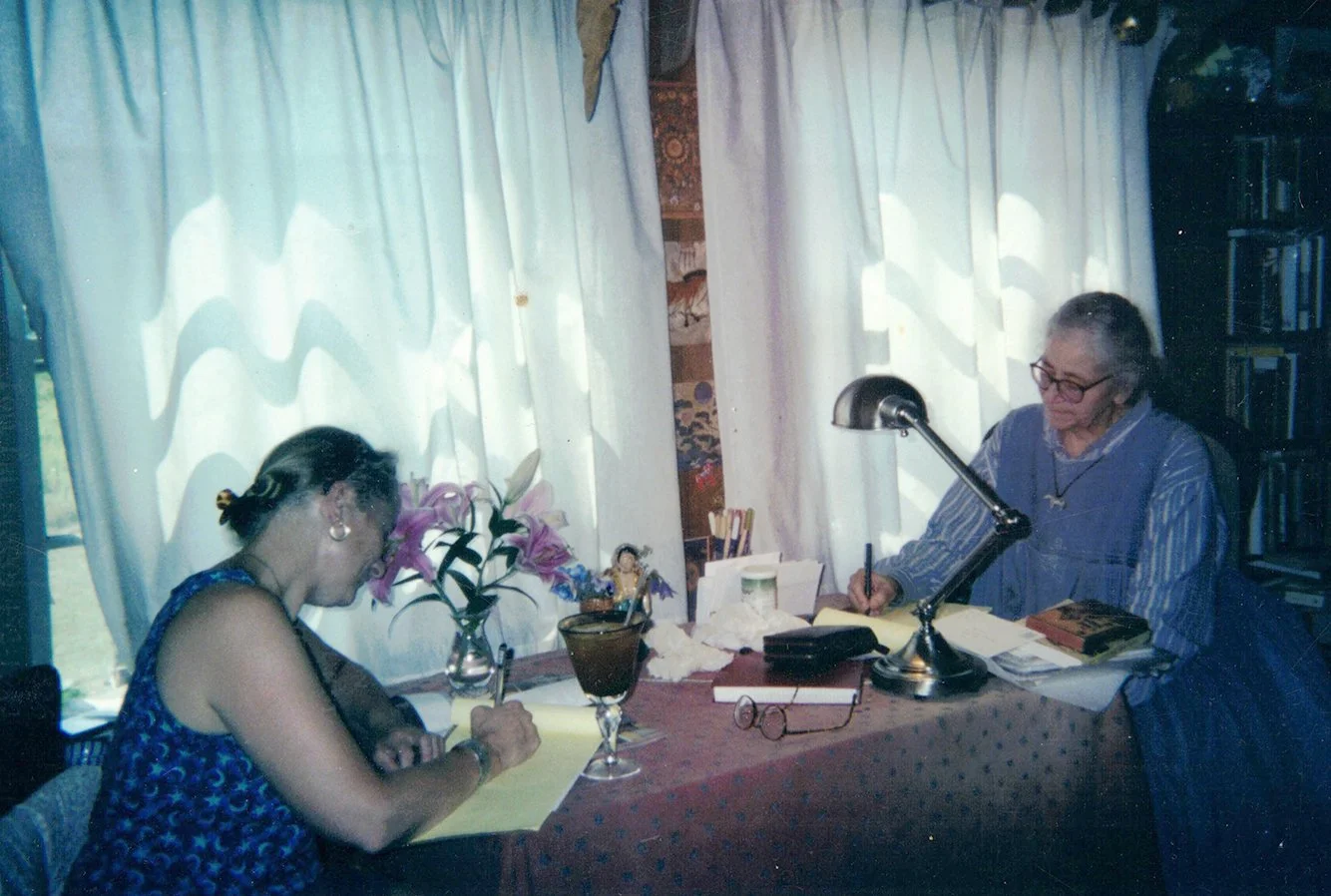
Elizabeth and Kate Barnes
Kate’s life on the ridge and her past filled her poems. Children, abusive marriage to a man she adored, beloved horses, dogs, friends, her study of mythology and dreams. She wrote with reverence about her mother, Elizabeth Coatsworth, Oh, she is still a bird that fills the bush with singing, and her unease with her father, Henry Beston, safely at work on a new book, away in his study. She told me she was like her mother in her writing practice, but in style, her father. Kate wrote first drafts by hand in beautiful printing, sometimes illustrating the margins. Draft after draft. Final copies for submission she typed into a word processor.
Now, opening her books carries me back to her table, where we sat gossiping, writing, reading poems. Her house was a holy mess filled with treasure. The carved wooden dragon’s head that had been the downspout at Chimney Farm. An early Chinese pottery horse. The Buddha her mother smuggled, inside a travel case, out of Asia. Sculptures and paintings. Old limby geraniums pressed against the picture windows, and petaling the floor. Books everywhere, shelved, piled and strewn. Loose poems and Kate’s drawings. Chairs filled. The sink and counters heaving with dirty dishes. And Kate’s Bernese Mountain Dog asleep at her feet. All a heavenly museum coming undone with room for a visitor, cup of tea, notebook and pen.
Kate and I were friends for the last 24 years of her life. Not long enough. When she died, I cried over her big hands. There was no trace of her in her face. But she still resided inside her hands, where her essence was distilled to her fingers, her pencil, pen and brush.
Sunstruck
with lines from Kate Barnes
Stop staring at me, you snapped the day before you died.
As though I could hold you back. I couldn’t comprehend
your death even as you left, your face empty. Your hands grieved me
as I held them, the poems inside alive as an invisible pen wrote
across the page with a pencil of light.
Now, I imagine you,
head bent, pen moving, writing this winter afternoon: low sun
flooding gold over farmhouse and icy road, a slate-gray sky
above the hills. Because I, sunstruck, can’t write.
You wrote light
as though your pen were a brush. It shone in your lines.
My mother, that feast of light. As were you. Eyes shining as deer eased
through your night fields. Orion bright.
This winter’s snow, rare now,
vanished beneath pounding rain. Streams boiled and overflowed.
And now this burning twist of cold weather. It’s the here
and then not that astounds me. No matter how many bare winters
or deaths. No matter the dozen years you’ve been gone.
As though a hole
rent the quilt I’ve spent my life stitching. It is not light shining through
but utter darkness where bones reside. I stare into the distance inside
the stone. I find I am bending lower and lower.
I imagine Kate still out there. Reckless and well. She wraps a cape around her shoulders, grabs the spotlight in the cellar, heaves herself into her 4WD and backs out into the night. The ground is crisp with frost, the stars sharp. Up the Ridge Road she turns through a break in the stone wall and roars up over a field track, gravel and leaves crunching beneath her tires. At the highest point, she steps out in flipflops and shines her light down the hillside to the woods and waits. Until she sees shining eyes, proof that her world is still wild with deer.
Elizabeth Tibbetts grew up in Camden and now lives in Hope with her husband. She writes about her work as a nurse, her roots in Maine, and her love for the natural world. Her book Say What You Can was published by Deerbrook Editions in 2019.