Red-Weather Tigers
Mike Bove on Mekeel McBride
In my first year of grad school at the University of New Hampshire, I took a course on preparing a freshman composition class. It was the only class on teaching I ever took, a fact not lost on me after twenty-plus years teaching in higher ed. In truth, I don’t remember much about it aside from thinking it wasn’t nearly as fun as my seminars in, say, Transcendental Poetry or British Romanticism. But one thing about it I’ll never forget: an in-class visit from poet Mekeel McBride.
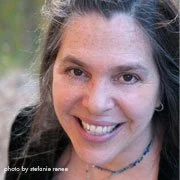
Mekeel was teaching in the MFA program then. I was on the academic track, too nervous to go the MFA route, though by then I’d started writing my own poems in relative secret. I can’t recall the purpose of her visit, but I’m sure it had something to do with strategies for engaging students. She walked in smiling, comfortable, and sat down with us. She spoke about the mystery and beauty of poetry. Then she read. Not her own work, but Wallace Stevens’s Disillusionment of Ten O’Clock:
The houses are haunted
By white night-gowns.
None are green,
Or purple with green rings,
Or green with yellow rings,
Or yellow with blue rings.
None of them are strange,
With socks of lace
And beaded ceintures.
People are not going
To dream of baboons and periwinkles.
Only, here and there, an old sailor,
Drunk and asleep in his boots,
Catches tigers
In red weather.
My head spun. I’d never read any Stevens. I don’t even think I knew who he was, and I definitely had no idea what the poem was about. It didn’t matter. Mekeel read the lines with reverence, the colors bursting from those imagined nightgowns, those periwinkles and baboons. It brought me to a place only good writing can, a place of possibility and wonder. She talked about the poem’s images and how, to her, they were far more consequential to a reader than what the poem “meant.”
I barely knew anything then, but I knew I agreed. I felt she was telling the truth despite what the academic part of my brain was saying. Burdened by insecurity and perceived intellectual shortcomings, graduate study frequently felt stifling. In my free time, I experimented with writing my own fiction and poetry, but even that felt difficult. I didn’t know what I was doing, and not knowing was frustrating. I wanted answers. But listening to Mekeel, it was clear she believed not knowing something was ok and, further, that there was great beauty in not knowing. At that time in my life I needed permission to be awe-struck, and she gave it to me.
Poets travel together in circles that expand as we meet other writers who, in turn, introduce us to still others. Decades later, I became friendly with poets who knew Mekeel. Then, in the strange way social circles work in the 21st century, she and I connected online.
It’s not often we get a chance to tell someone from our distant past how important they were to our development. Though small, that early moment with Mekeel informed so much of my own writing and teaching. How lucky I was to be able to tell her as much. And later I heard she’d told others about my telling her, which felt good, felt important. From time to time, I’ll post a poem of mine on social media, or a notice of some event I’m doing, and she’ll comment in her kind, generous manner. That feels important too. Not in a teacher-to-student way, or even a poet-to-poet way, but in a person-to-person way. A shared human way.
In my own classes, I don’t teach Disillusionment of Ten O’Clock. I keep it close, just for me. But I do teach Mekeel’s work, particularly my favorite of her poems, Taking Pleasure, and I’ve lost count of how many students have been entranced by it, or just rendered speechless by the nearly indescribable state of pleasant confusion good poems bring us to. When that happens, I usually let them sit with those images, questions unanswered, hoping they’ll take the poem with them long after they leave.
That’s what happened to me. Mekeel gave me a small gift that keeps giving. At the end of her visit to class that day, as she was wrapping up and preparing to go, she said, “I still think about those tigers.” So do I.
Mike Bove is the author of five poetry collections including Mineralia, forthcoming from Cornerstone Press at the University of Wisconsin Stevens Point. He lives in Portland, where he was born and raised.