Millay House Rockland Membership: Keeping the Conversation Going
Mark Raymond
© The Mystic Stamp Company
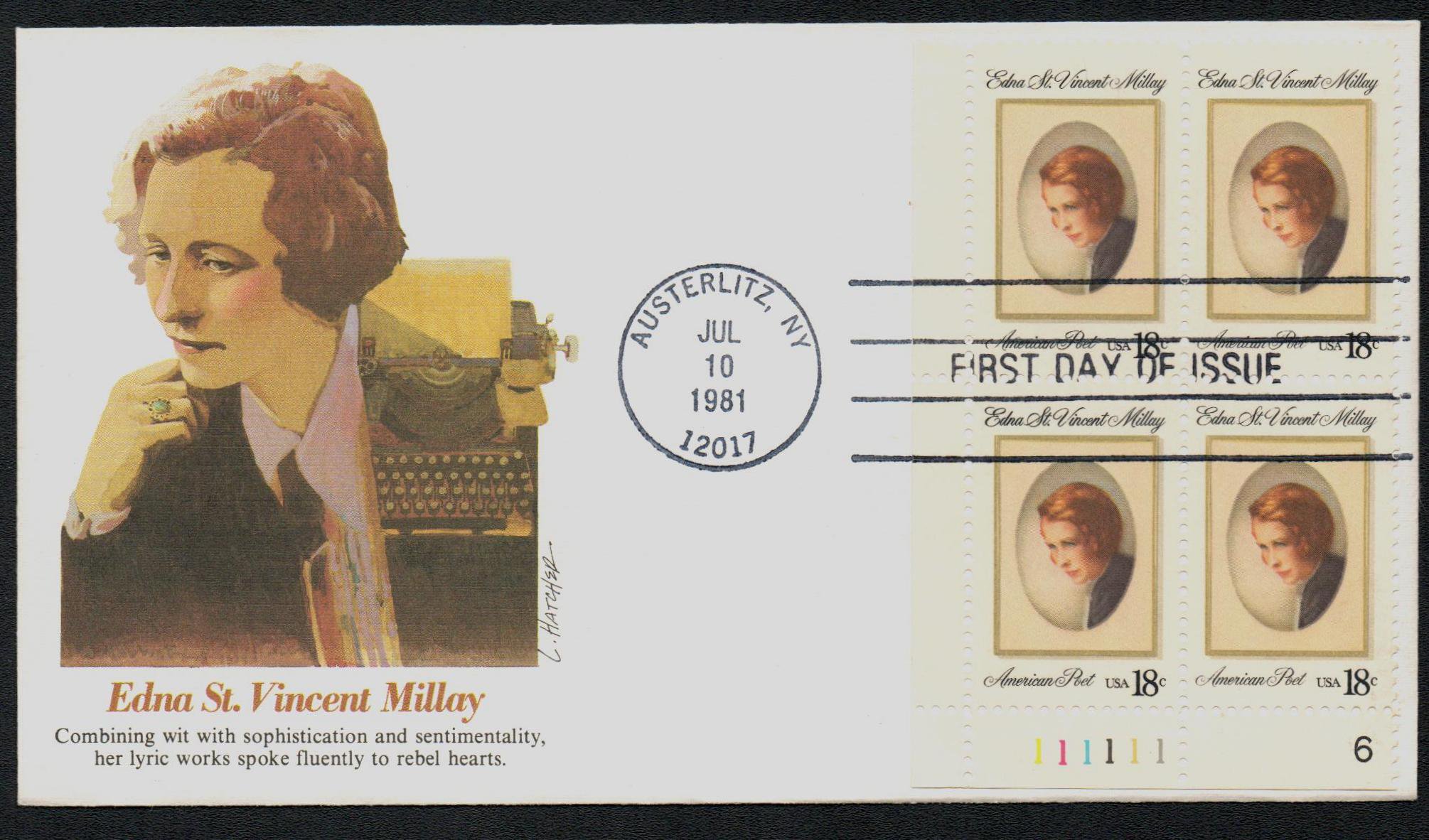
The Millay House Rockland Third Fig Review is a poetry-focused conversation between Maine writers, and it’s open only to you, MHR members. It’s our way of thanking you for being part of our on-going mission to preserve Vincent Millay’s legacy by fostering the literary arts in Midcoast Maine, keeping alive the spirit of her voice in the part of the state where she grew up.
And your part has been essential. Our readings, workshops, and special events, our juried writers-in-residency program, all that Millay House Rockland gives to the community couldn’t be realized without the generosity of members like you.
Millay is having a bit of a moment these days. We all know her as a Jazz-age New Woman who was, in the literary circles of her times, as much of an It Girl as Taylor Swift, but I can say that, having grown up in Rockland and gone on my own way to study literature, Millay’s life and poetry are better appreciated now than any decade I can remember.
How many of us were delighted last spring by A.O. Scott’s five-day “Poetry Challenge” in the New York Times? We got to know Millay’s “Recuerdo” better day by day. We followed along, stanza by stanza, line by line, until the poem felt almost like how we might recall an old friend, or like those quick-bonded intimacies that form at summer camp.
Where did the experience take you? First of all, probably, to the poem itself, and for longtime readers of Millay it would be more of a reunion, a getting back in touch, maybe a rekindling in a way. Didn’t the challenge feel like a series of dates, reminding us of the scenario of the poem itself, its Before Sunrise Romcom/Rom Drama feel?
“Recuerdo” was meant to evoke memories. I too was once young in New York and stayed out all night (“it’s wonderful to . . . drink too much coffee and smoke too many cigarettes and love you so much,” as Frank O’Hara wrote).
Where else did the Poetry Challenge take you? Did you end up on the ferry like in the poem?
A.O. Scott called attention to the NYC-centric detail of the ferry-crossing and reminded us how poets after Millay, like Audre Lorde on the Staten Island Ferry, have drawn on similar, shared experiences, as poets before them had also done, most famously Walt Whitman in “Crossing Brooklyn Ferry.” Is it a coincidence that the May 1919 edition of Poetry magazine in which “Recuerdo” first appeared happened to be the “Whitman Centenary” issue? The series of poems that open the magazine before Millay’s poetry all invoke Whitman in some way.
As A.O. Scott reminds us, Whitman includes us in the crowds he imagines crossing with him on the ferry. Even unborn generations of readers can’t decline his embrace, can’t be left off one of his endless lists. We’re all members of his imagined community. We’re with him, as we are with Millay, and, with her, the poem itself becomes something we love. We don’t have to see it just through the poet’s eyes, whomever she might have been talking to, face to face, wearily and merrily, as the sun rose on New York. This love is part of our own ongoing romance with language, the essence of the conversation between readers and poets that the Millay House Rockland aims to keep alive.
This December edition the Third Fig Review contemplates the lives of poets that get kept out of their poems, and the clues that Maine writers have followed show that these encounters are never random. We’re never just strangers on the ferry or subway looking down at our phones. There’s something determined in our remembrances when poetry and poets are involved—the experience might be normal but heightened and alive, like the language of poetry itself.
The Millay House Rockland was delighted this past Fall to have A.O. Scott in person, face to face, for our “Conversations with Dead Poets” event, along with Maine poets Julia Bouwsma, Samaa Abdurraqib, and Rosa Lane. Membership in the MHR brings events like this (and many more) to Rockland, Maine. Who knows what Gen-Z poet Vincent might attend one of our readings or participate in one of our workshops? What might it mean to them to be included in these conversations we’re having about poetry?
Thank you all, as MHR members, for being as determined as we are not to let these moments pass. If you haven’t had a chance to renew your membership, please consider doing so now.
Thank you for helping us keep these conversations going, between poets of different generations, between poets both living and dead. Nowhere else can you hear Millay’s lyrical voice joined by so many other Maine voices. These communities don’t happen by chance. Thanks again for joining and being a Millay House Rockland member.