Millay and Me
Judy Kaber on Edna St. Vincent Millay
Love is not all. That’s what the poem says at the beginning, but then of course Millay turns and contradicts herself. Maybe not all. But love is something you don’t let go of lightly or easily forget. A year ago I lost my love of 42 years. Sometimes we don’t have a choice to trade or sell. It’s just gone.
Reading Millay’s poems, journal entries, and letters has been helpful to me in this loss. Most of her poems are so perfect, meticulously crafted. But that’s not true of her life, and I love that about her. As a teenager, a friend encouraged her to keep a journal. The friend wrote every day. Millay intended to but couldn’t follow through. Her entries were intermittent. That’s the kind of journal-keeper I am. When I look back, there are weeks or months between entries. My sporadic writing tends to reflect the ecstatic, the angry, the puzzled, the despairing. I wrote when I felt pressed to write. Otherwise I let the days slide by. I don’t feel guilty about not writing daily entries now, though. If a writer of Millay’s caliber can be so irregular, I guess I can forgive myself for this small fault.
I especially liked The Letters of Edna St. Vincent Millay, edited by Allan Ross Macdougall (Harper & Brothers, 1952). They showed a different side of her than her poems, let me follow some of the events in her day-to-day life. She displays a wonderful sense of humor in her correspondence which was helpful to me in trying to find the brighter things this past year. Here’s an excerpt from a letter she wrote to her sister, Norma, from September 1921, when Edna was in Paris.
And speaking of blackberries, you might write me a letter once in a while, I should think. How about it? What if your fountain-pen is lost or busted or stolen or something else as good as dead, and you can never find a pencil with a point, and mother has the Fox, and the only scrap of paper you can find is the back of a bill from L.P. Hollander or the margin of an invitation to tea from Davy Belasco, and you can never remember how much the postage is to France, anyhow, and besides you never have a stamp, anyhow, and there’s never any place to rest your elbow whilst you write except in a pot of massage cream, and the only envelope you can possibly find in the whole goddam flat, besides those that are sketched over with obelisks and church-steeples and muscular undressed hussies, is the one that you have already addressed to Riegie and then decided not to write him after all,—nevertheless how about it? Rise on your legs, you poor piece of imitation Camembert, and write your loving sister a little note.
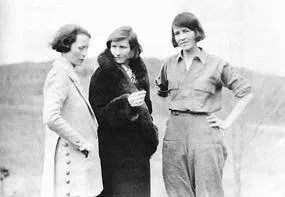
Millay with her sisters Norma (center) and Kathleen (right).
Photo: Manuscript Division, Library of Congress of Yale University Press
You can sense the closeness she feels to her sister, their shared history as well as her sharp wit and brilliance with language. The irony is that, though she chides her sister for not writing more often, she herself was pretty haphazard in her correspondence, even with those she loved.
One of the poems that struck close to home last year and that I’ve gone back to is Millay’s untitled sonnet, Time does not bring relief; you all have lied. I used the poem in a monthly column I wrote for The Midcoast Villager just a few weeks after my husband’s sudden death. In the article I cited the fourth line in Millay’s poem as the most meaningful to me at the time: I want him at the shrinking of the tide. The poem was first published in 1917 which makes Millay around 24 when she wrote it. At that point in her life she had yet to experience first-hand any of the devastating loss that death brings so it is credit to her empathetic imagination that she captured these feelings so well. Later, she would experience a number of deaths that pierced her deeply: her mother, Cora; her friend and fellow poet, Elinor Wylie; her long-time platonic lover, Arthur Ficke; and, most devastatingly, her husband of 26 years, Eugen Boissevain. Millay died at the age of 58, just 14 months after her husband. I don’t know how long I’ll live. A long time, I hope. But I think of my husband, Dan, and the pain of his death will always be a part of me. I can’t help but think of the ending to Millay’s 1917 poem:
There are a hundred places where I fear
To go,—so with his memory they brim.
And entering with relief some quiet place
Where never fell his foot or shone his face
I say, “There is no memory of him here!”
And so stand stricken, so remembering him.
Judy Kaber’s poems have appeared in journals such as Rattle, Pleiades, december, Poet Lore, and Prairie Schooner. She is a past poet laureate of Belfast, Maine.