Home and Away: Can a Poet Grow Up in Rockland?
Mark Raymond on Leo Connellan
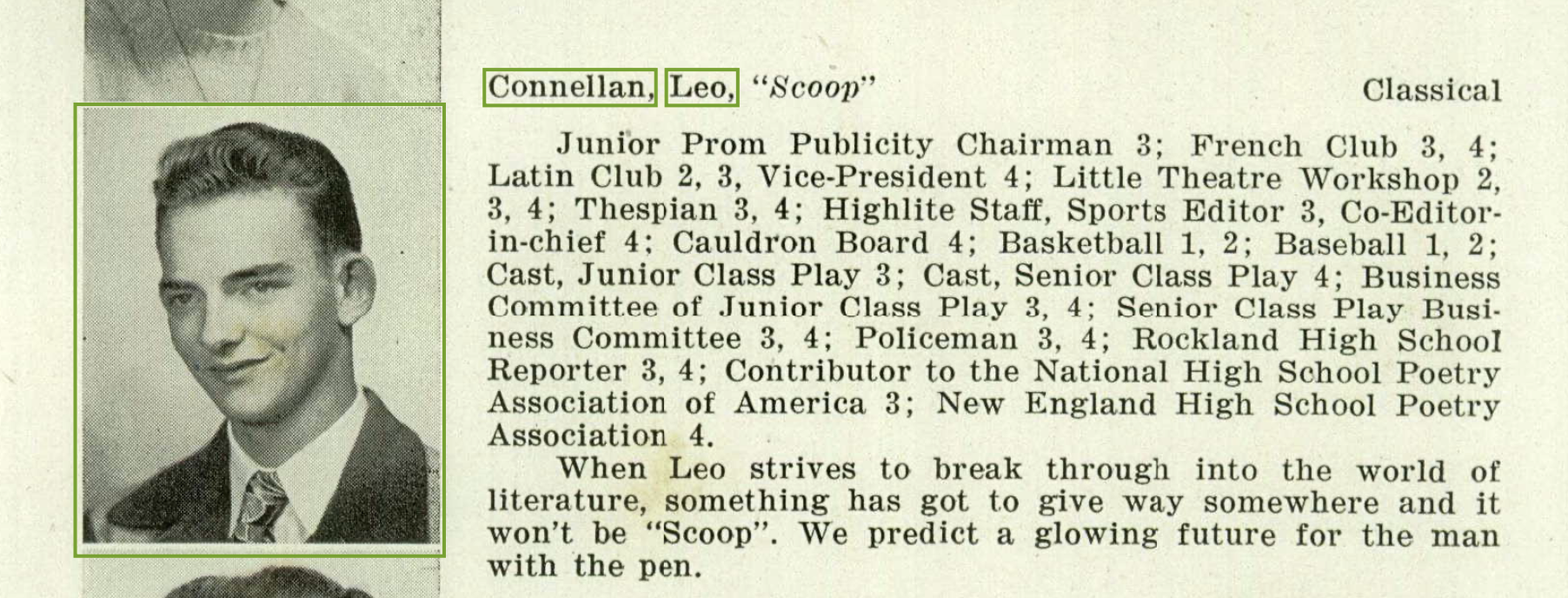
I never wrote a letter to Leo Connellan, but there was a time when I should have, when it would have made sense and would have been appropriate. But I didn’t. I was young, and there’s a loss in that, as there’s always a loss in one’s youth when one looks back at it, when life seemed so full and the hours so quickly emptied.
Connellan and I were both from Rockland, Maine. For him, Rockland was the town of his youth, the place he was always escaping from and returning to in his writing, that cussed place in his imagination which says so much about his life and art. Rockland says something about me as well, but I didn’t know much about life and art when I first met Leo.
The first time I heard him read I felt that out of the entire audience that night only I, being from Rockland, Maine, understood him.
I was a student at Bates College in the mid ’80s. Connellan gave a reading in Chase Hall. He was then finally getting his due—a brief season of lionizing for an “everyman” poet who left Rockland and Maine as a young man for New York City and the hard work of life as a poet—although I wouldn’t have known it at the time. I was a scrawny teenager with long hair and a beard. He was introduced as an established writer.
I thought a lot about poetry in high school and college, and wrote some. I got lucky. In my teens, I published in the old local Courier-Gazette and in the old Maine Times, as well as in the extant Hanging Loose out of Brooklyn. It still has a section for high-school-age poets, no Telling Room in Maine in the ’80s.
I was studying with the poet John Tagliabue at Bates. Did he facilitate my speaking to Mr. Connellan? I can’t recall. What sticks in my head is the uncanny recognition of knowing exactly what Connellan was saying when he read from his long poem “The Clear Blue Lobster-Water Country,” even though he fictionalised his truth, changed names, and wrote in coded poetic vernacular. He was speaking about people, events, and places I thought I knew: in particular, the shooting in the early ‘80s of Rockland lawyer Peter Sulides.
The Sulides girls were a grade below and a few grades above me in school. My Greek-American mother told me I could talk to the Sulides girls about baklava. This was my mother, who had married a non-Greek seemingly to live her life without having to speak about baklava, yet didn’t think anyone without a baklava-adjacent heritage could appreciate it. Hers was the schizophrenogenic mother version of the ethnic assimilation/appropriation double-bind: Don’t make me talk about baklava; only I can talk about baklava. I never talked to the Sulides girls about baklava.
After the reading, I went up to Connellan, talking to him about Mr. Sulides, saying I was from Rockland, that I knew what his poem was about. He was generous but cranky, as if I were stepping into a cussed personal space and he felt obliged to invite me in.
He took me with him to the house just off campus that Bates must have arranged for him and his wife during their visit. I brought along another Maine friend, Ben Taylor from Mount Desert Island. At the house, there was a bottle of whiskey and Leo’s brother and his wife.
Leo wasn’t drinking. Ben and I drank. There was a tension in the room I couldn’t parse. I was confident in my growing skills as a close reader of poetry, but poets themselves? Shouldn’t I have recognised the idiom and allusions, the tropes, the genre of some intergenerational narrative? Leo cussed his brother after he left, having stayed just long enough to be impolite. No one else from the Bates community was there.
Ben and I drank and listened. Drank more than we should have and listened less than I now wish we had. Stumbling along the Lewiston streets after we left him with his wife and a depleted bottle, Ben was ecstatic, more with the whiskey than anything else, yet he seemed to revel in the glow of the evening as an entrée into some privileged literary sphere. (Ben once shared a dream in which Bates English Department chair James Hepburn’s cramped office secretly opened into a book-lined Edwardian salon, clubby with leather, woodwork, and academic status.) I found it sad, though, the way the Lewiston streets always seemed sad. The house they’d put him up in reminded me of a classic multi-camera sitcom set—“filmed before a live studio audience,” like All in the Family, wives off in the kitchen behind louvred doors, stairs going to bedrooms you never see. While Ben raved, I thought it was all like something I’d already watched.
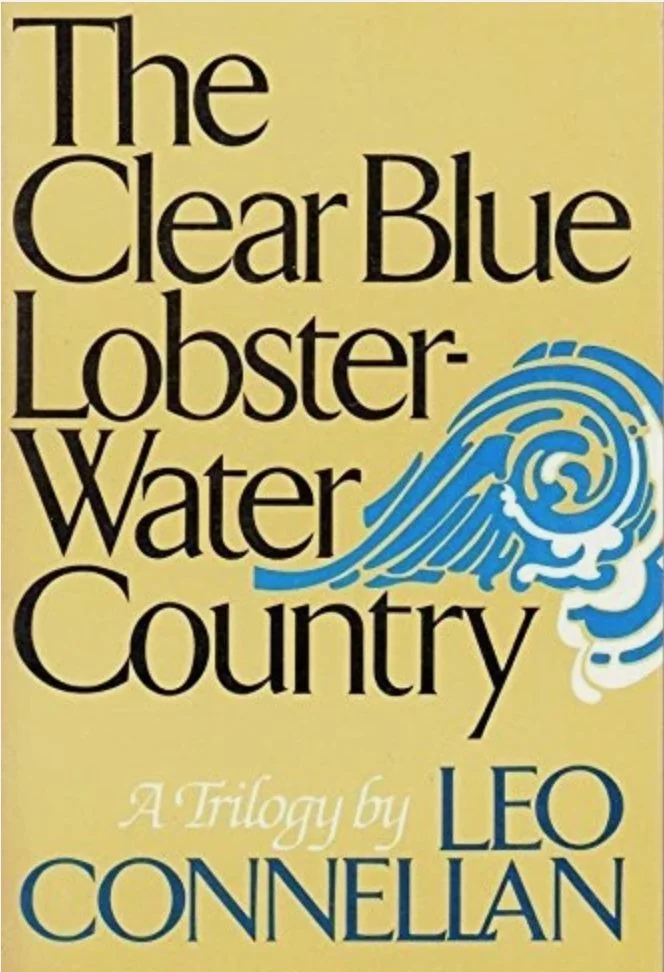
It would take me years to align my memory of Leo Connellan talking kind of creepily about Poe’s “Annabelle Lee” with a deeper, more committed reading of his poetry, especially the full book-length Clear Blue Lobster-Water Country trilogy, which had yet to be published when I saw him read. The unhealed woundedness of Irish Catholic family history in a Maine working-class fishing community, the way Connellan works it into rough myth, is so peopled with loss that even the smooth perfections of poetry are heartbreakingly close to the curses we throw at each other in real life trying to survive.
Maybe Ben was right. Maybe I should have followed up our encounter with Leo Connellan by writing to him, showing him some poems, my scrawny attempts at something so much bigger than I was. I didn’t though, and I’m not sure why. Nothing tells me that Leo Connellan wouldn’t have been kind and mentoring, or at least polite, to a college kid. He was soon to be named poet-in-residence for the Connecticut State University System, ultimately serving as the state’s Poet Laureate. An invitation seemed to be open, not to some mythic, dark-academic lounge where literary lights smoldered, but to something real and uncomfortable that was far truer than dreams or myths. Indeed, it was an invitation to the source of our tragedies and our farces, something disquietingly human and darker because it closed on our shames and desires.
I didn’t know all that then. I was equally sickened and elated on those hushed Lewiston streets, like many a college student after midnight between The Goose and The Cage, under the shadow of the unfillable basilica. I realized, though, that I was wrong about how I knew his poem: my knowing Rockland hadn’t yet grasped the responsibility for loss which strong poetry never turns away from. It’s an unknowability we carry with us even as we flee, however justified or prodigal our escape—that creeping nostalgia and painful uncanniness that we don’t belong in our own home. However truthfully we come to write about it, we fail again in the same ways, wanting to be loved by the rejected place we create in our own hearts. For Connellan, it was the Rockland he recreated in his poems as Lime City.

Connellan, seated, and the author waiting in line at an event in Rockland. Credit: Maine Public Television.
Leo Connellan was pissed about something that night. Maybe he’d been pissed about something all his life. As he would write in one of his poems, “Maine cannot provide for its bright youth.” Here I was at Bates, a Dirgo Scholar, my tuition provided, a work-study job. Was I Maine’s bright youth? Those always sad Lewiston streets have a way of dimming your prospects when you try to look ahead. My Greek grandparents lived here once, in one of those boxy triple-deckers, my grandmother straight from her village and an arranged marriage, no English to speak of. One feels like an imposter, asking “What am I akin to here?”
Our poetic kinships may seem like genealogies we choose, imagined communities with different streets, clean thresholds to step across, an invitation to join those voices untouched by time. But cramped and stubborn life forces us into unwelcomed corners, lights out in the houses, doors locked. Listen to Connellan’s voice when asked about his place among the renowned poets of Maine:
“Do you have any feelings of kinship with the other great Maine poets like [Edwin Arlington] Robinson, [Robert P. Tristram] Coffin . . . and who are the other Maine poets? Millay. Edna St. Vincent Millay . . . Who else?”
“Well, no. Millay, now you know, don't you, that Edna Millay and I both come from Rockland, Maine . . . let's see, I'll tell you something . . . [ . . . ] I'm a loner. I'm so unrelated to them.”
“. . . [A]nd who are the other Maine poets?” playwright and poet William Packard asks, before remembering Edna St. Vincent Millay. Edwin Arlington Robinson has his place in the anthologies (and three Pulitzers), but who’s been reading Robert P. Tristram Coffin recently? It’s funny how barren (and dated) the Maine poetic landscape seems from Packard’s New York-centric perspective, Millay herself almost an afterthought, not quite there. Packard’s conversation with Connellan is from the mid ’80s, my college years. When Connellan answers the question about his “kinship” with Maine poets, he pivots and positions himself among other groups of writers, identifying them as individuals he’s learned from, who’ve helped him at his craft, but he ends up claiming to be “a loner.” It’s an odd moment. The interview coincided with a period of peak recognition for Connellan. He’d just won the major Shelley Memorial Award from the Poetry Society of America, his acclaimed trilogy The Clear Blue Lobster-Water Country was being published, and he was on the verge of being named poet-in-residence for the Connecticut State University System. This should have given him some sense of writing-career security—he’d made it, in a way.
I know now that “making it” in poetry is harder than those mill jobs and restaurant work my grandparents, the Mainers and the Greeks, had to do to survive. You can easily be alienated either way. Those sad streets “no longer remember” us, as Leo wrote in a poem about Rockland. What are we “akin to” when we create a memory in poetry? And when readers think, “I recognise these streets, I know this place,” where are they, in their own hearts? What cussed emotional truth have they stumbled upon? I’m still writing Leo to find out.
Mark Raymond was born in Portland, Maine, and grew up in Rockland and Owls Head. He received his PhD in English Literature from New York University and now teaches for the UMaine Honors College and serves on the Millay House Rockland board.